
Elvira Kohn (Rijeka, 1914 – Zagreb, 2003) was one of Croatia’s first professional female photojournalists and the only woman photojournalist in the propaganda department of ZAVNOH, the State Anti-Fascist Council for the National Liberation of Croatia. Of Jewish origin, she survived the Italian concentration camps at Kupari and at Kampor on the island of Rab. Her path took her from studio photographer in Vinkovci and reporter for Foto Jadran in Dubrovnik to Partisan photojournalist and, finally, head of the photography department of the Yugoslav People’s Army Hall (Dom JNA) in Zagreb.
Her life is best documented in an extensive interview conducted by Lea Šiljak in May 2003, a few months before her death, for the Vienna-based institute Centropa. Alongside that interview, this text draws on the work of Croatian historians of photography and culture and on a study by the Polish Slavist Katarzyna Taczyńska.
Elvira Kohn was born in Rijeka in 1914, at the very beginning of the First World War. Her father, Bernard Kohn (born in 1887 in Koška near Našice), was a merchant and a manager at a textile manufacturing company. Before Rijeka, the family lived briefly in Vienna, where her brother Aleksandar was born in 1912. Bernard was taken prisoner in Niš as an Austro-Hungarian soldier and died there of typhus in 1915, when Elvira was one year old (Centropa, interview; family tree).
She learned the photographic trade at the private Seiler studio in Vinkovci, where she qualified as a photographer. Over time she grew tired of static portraits and of posing people in the studio and, by her own account, wanted to work outside it, as a photojournalist. The opportunity soon came when, through a merchant, she was invited to work in Dubrovnik.
In early 1932 Elvira moved to Dubrovnik, and her mother soon joined her. She took a job at the Jadran shop on the corner of Žudioska Street, right next to the synagogue, owned by the publisher and bookseller Miho Ercegović and his son Velimir. The shop housed a bookshop, a stationer’s and a photo studio, and the people of Dubrovnik soon nicknamed the young photographer “signorina Elvira”. As a reporter she photographed cultural and political events, church ceremonies, christenings, children’s birthdays and events for the newspapers. According to Barbara Blasin and Igor Marković, Kohn, unlike her female contemporaries tied to studio photography, leaned towards documentary work and developed as a photojournalist (Makabijada, after Ženski vodič kroz Zagreb).
Davor Konjikušić distinguishes two strands of her work in this period. For Ercegović she took commercial photographs, while her own artistic work was influenced by New Objectivity, the German Neue Sachlichkeit(Konjikušić, Crveno svjetlo, p. 64). This interwar movement cultivated a sober, sharp and precise view of objects and people.
After the Independent State of Croatia (NDH) was established in 1941, Ercegović’s business partner demanded the dismissal of Jewish staff. Under the new decrees every Jew had to wear a prominent letter Ž (for Židov, Jew), and Jews were also banned from working in public services. Ercegović, however, dismissed her only formally, and she secretly kept working for him. She also covered a large NDH celebration in front of the Church of St Blaise, which she herself dates to April 1942. The other photojournalists were busy, so the assignment fell to her, Leica in hand and the Jewish badge on her chest. When Ustaša officials recognised her, she had to stop working, and the Ercegovićs later told the authorities that the films had been destroyed and the photographs never developed. Dubrovnik was then under Italian military administration, which rejected German and Ustaša demands to hand over the Jews. Miho and Velimir Ercegović are on the list of Croatian Righteous Among the Nations (D. Žubrinić’s list), while Taczyńska’s bibliography refers to an entry on the Ercegović family in the Yad Vashem database.
In November 1942 the Italian authorities rounded up Dubrovnik’s Jews, as well as those who happened to be in the city or had taken refuge there, and put them on a passenger ship. Miho Ercegović was at the quay. When Elvira tried to give him back the camera, he told her to keep it: “Whatever happens to you, let it happen to the camera too” (Makabijada). Konjikušić gives a translation of Elvira’s account from the interview, in which Ercegović tells her to keep the camera so that everything that happens will be recorded on film (Crveno svjetlo, p. 64). This version is faithful to Centropa’s English transcript.
For the first two months the Dubrovnik Jews were held at the Hotel Wregg in Gruž, and in early January 1943 they were moved to Kupari, to a hotel fenced in with wire that held some 1,200 internees. Food was scarce and movement was limited to the area around the building (Centropa). In May 1943 the internees were transferred to the Italian camp at Kampor on Rab. The camp had separate sections for Slovenes and for Jews, and the Jewish section was divided into a “Dubrovnik” and a “Kraljevica” part. Elvira and her mother slept in brick barracks with about thirty other people, where searches and abuse took place during the day.
Elvira volunteered at the hospital in the Hotel Imperial in the town of Rab, where she helped sterilise bandages and prepare medical instruments. Out of sheer defiance, as she put it, she refused to sew buttons on Italian uniforms. Throughout her internment she hid her Leica with the help of a network of inmates, who moved the camera from barrack to barrack after every new search. Sources differ on whether she took photographs in the camp. In the 2003 interview she says she did not photograph during her internment because it would have been too dangerous. Blasin and Marković, on the other hand, write that she used the smuggled Leica to take what are now historic photographs of the camp’s liberation in September 1943.
Her notes from the camp have also survived; Lucija Benyovsky based her 1996 study on them, and in 2018 Katarzyna Taczyńska analysed her photographs together with her diary and a poem (Taczyńska, abstract).
Tragically, in 1942 the Ustaše took Elvira’s grandparents, the Kleins of Vinkovci, to Stara Gradiška, from where they never returned. Her maternal uncles Samuel and Dragutin Klein were murdered in Jasenovac, as was her fifteen-year-old cousin Mirko, while her father’s brothers and his sister Elza with her husband were later murdered in Auschwitz.
After Italy’s capitulation on 8 September 1943, Partisans from Crikvenica arrived on Rab. Elvira told them she was a professional photographer and had a camera, so they invited her to join them in the ZAVNOH propaganda department in Otočac. Her mother went with her and worked there, first in the kitchen and then in the hospital pharmacy (Centropa). They reached Otočac by ox cart, through ruined Senj and over the Velebit mountains. Elvira photographed sessions, conferences, exhibitions and concerts, and everything that happened in the body that functioned as the first Croatian government. She thus became the only woman photojournalist in ZAVNOH, and indeed among the Partisans as a whole. Ahead of the German offensive, the war took her from Otočac towards Slunj and Plitvice, through Glina, where she lived through the bombing of 13 January 1944, and on to Topusko. She also survived the bombing of a convoy on the way to Zadar, in which the very truck she was riding in, number 13, was hit.
She was also the first woman war photojournalist for Vjesnik. Among her well-known war photographs are scenes of children and refugees in Topusko, the wounded on Petrova Gora, the third session of ZAVNOH and the rally in Ban Jelačić Square after the liberation of Zagreb. Blasin and Marković highlight her eye for detail that never breaks the unity of the frame (Makabijada).
She entered liberated Zagreb on 9 May 1945 at around 5 p.m., across the Sava Bridge, as people in the streets welcomed the Partisans with applause and flags. She spent her first night in the city with a group of comrades in Pavelić’s former headquarters on Zvonimirova Street, chosen deliberately as a sign of victory over the Ustaše. The courtyard still smelled of the smoke of burned documents, and she slept on a table in her army coat, with a pistol under her (Centropa; Konjikušić, Crveno svjetlo, p. 64).
After the war, the Main Headquarters of Croatia assigned Elvira to the newly established JNA military command in Zagreb. There she set up a photo laboratory from scratch, procured equipment and gathered collaborators, and she soon became head of the photography department. She supervised the work of others but also photographed intensively herself (Centropa). She covered Party meetings, celebrations of 8 March, 1 May and 25 May, and commemorations. Her photographs were published mainly in Vjesnik and Naprijed. She headed the photography department of Dom JNA until her retirement in 1964 (Centropa, summary).
Blasin and Marković also point to the other side of this period: after 1945 Kohn gave up classic news reporting and lived a relatively secluded life (Makabijada). The sources thus agree on her service at Dom JNA but differ in how strongly they stress her public visibility as an author in those years. Especially important for understanding her body of work is what she herself said in 2003: she also often photographed for her own pleasure – nature, people she loved, friends, her friends’ children and children she saw in the street.
It is precisely this part of her work that was saved from destruction, preserved by Unwanted Images and turned into the separate Elvira Kohn collection. The photographs were taken during her two decades at Dom JNA, and so far less has been written about this collection and these photographs than about any other part of her work. Elvira Kohn donated the rest of her archive to the Museum of the Revolution, today’s Croatian History Museum, where, according to what she said in 2003, it is still kept (Centropa).
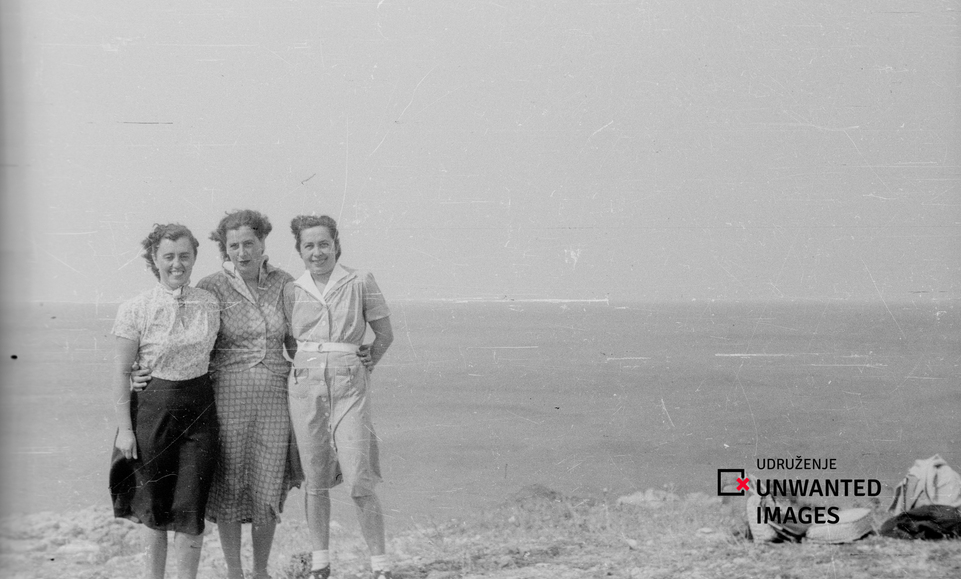
Elvira Kohn with friends in Dubrovnik after the Second World War.
She never married and blamed photography and constant travel for it. One suitor, she recalled, told her: “You love your camera more than me!” She lived with her mother until her mother’s death in 1977. From 1945 she was a member of the Jewish Community of Zagreb and, at the same time, of the Communist Party, which she regarded as separate spheres of her life. She first travelled to Israel in 1950, and she died in Zagreb in August 2003, in her ninetieth year.
She had her first retrospective only in her eighties: the exhibition “Fotografije: Elvira Kohn. Retrospektiva” (Photographs: Elvira Kohn. A Retrospective) was held from 8 to 15 June 1997 at the Milan and Ivo Steiner Gallery of the Jewish Community of Zagreb, with a bilingual catalogue by Rhea Ivanuš (USHMM catalogue record). The exhibition also included photographs related to the Kampor camp.
She has been written about by Lucija Benyovsky (1996, on the Kampor camp, based on her notes), Barbara Blasin and Igor Marković in Ženski vodič kroz Zagreb (2006), and Renata Jambrešić Kirin (2015). The most extensive analysis is by Katarzyna Taczyńska (2018), who reads her photographs, diary and poem as a personal microhistory and a testimony to the emancipatory changes of the time.
Her interview is part of the Centropa archive, which has been taken over by the United States Holocaust Memorial Museum (USHMM), and her story is also told in Centropa’s short film Rifka and Elvira – Coming of Age in a Time of War.
Note: In its summary, Centropa states that Elvira was born in Sarajevo into a Sephardic family, to Leon and Esther. This claim contradicts both her own account and the family tree, so this text follows the interview and the family tree.
Sources
Benyovsky, Lucija: “Fašistički logor Kampor na Rabu prema sačuvanim bilješkama Elvire Kohn”, in: Ivo Goldstein (ed.), Antisemitizam, holokaust, antifašizam, Židovska općina Zagreb, Zagreb 1996, pp. 214–223.
Blasin, Barbara; Marković, Igor: Ženski vodič kroz Zagreb, Meandar, Zagreb 2006, pp. 205–211.
Centropa: Elvira Kohn – biography, interview conducted by Lea Šiljak, Zagreb, May 2003.
Centropa: Elvira Kohn’s family tree (PDF).
Centropa: film Rifka and Elvira – Coming of Age in a Time of War.
Hlevnjak, Branka: Fotografkinje. Prilozi povijesti hrvatske fotografije 1870.–2000., Društvo povjesničara umjetnosti Hrvatske / Design Art, Zagreb 2005.
Hlevnjak, Branka; Ivanuš, Rhea: Hrvatska antiratna fotografija: Prvi svjetski, Drugi svjetski i Domovinski rat, Design Art, Zagreb 2008.
Ivanuš, Rhea: Fotografije: Elvira Kohn. Retrospektiva, exhibition catalogue, Galerija “Milan i Ivo Steiner”, Židovska općina Zagreb, Zagreb 1997.
Jambrešić Kirin, Renata: “Med iz Jasenovca”, in: Korice od kamfora, Meandarmedia, Zagreb 2015.
Konjikušić, Davor: Crveno svjetlo. Jugoslavenska partizanska fotografija i društveni pokret 1941.–1945., Rosa-Luxemburg-Stiftung / Kolektor, 2018, p. 64. Open-access English edition: Red Glow, De Gruyter / Deutscher Kunstverlag, 2021.
Kovačić, Ivan: Kampor 1942.–1943.: Hrvati, Slovenci i Židovi u koncentracijskom logoru Kampor na otoku Rabu, Adamić, Rijeka 1998.
Makabijada: “Zanimljive žene: Elvira Kohn”, after Blasin and Marković (2006).
Taczyńska, Katarzyna: “A dokąd teraz? Problematyka obozowa w perspektywie jugosłowiańskiej. Przypadek Elviry Kohn”, Acta Universitatis Lodziensis. Folia Litteraria Polonica 47 (1), 2018, pp. 135–158 (bibliography).
USHMM: catalogue record for the 1997 retrospective catalogue.
Žubrinić, Darko: Croatian Righteous – Hrvatski pravednici.


